Solar Energy help Save, Money and Decrease GHG
🎯 🎯 Available now → https://amazon.com/author/sustainable-longevity-living?tag=gqsnet20-20
From Space to Home: The Future of Solar Power and Energy Independence
To see Benefits of using solar panels include reducing electricity bills, increasing home value, and environmental friendliness with Smart Solar plus Storage resilient
Get a free quote today! https://forms.gle/eMnsFdri37E4Rc8k8
Exploring space deepens our responsibility to preserve the only home we have
The same sustainable energy that sustains astronauts in space can sustain humanity on Earth
A Guide to — Sustainable Living: Achieving Life Longevity — Ebook
Available at Amazon Now, → https://gqsnet.org/slivingwill
International Collaboration: A Global Approach to Sustainability
The Artemis II mission is a testament to the power of global collaboration, particularly the partnership between NASA, Canada and the European Space Agency (ESA). Addressing Earth’s sustainability challenges similarly requires cooperation among nations, organizations, and communities.
Sustainable Longevity Living promotes:
- Global partnerships for clean energy deployment
- Knowledge sharing for public health and nutrition
- Cooperative efforts to mitigate climate shift
- Initiatives to reduce inequality and improve quality of life
Through collaboration, humanity can create a unified approach to both space exploration and planetary stewardship.
________________________________________
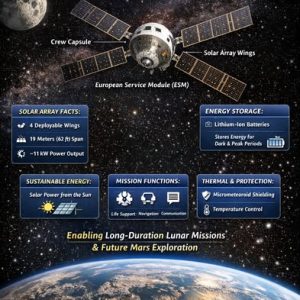
The Artemis II mission showcases the power of the Magic of Exponential Technology, sustainable energy in one of the most demanding environments imaginable—deep space. The Orion spacecraft’s European Service Module (ESM) is equipped with four photovoltaic (PV) solar array wings that generate approximately 11 kilowatts ( KW) of electrical power. This output is comparable to the energy required to power a large home in the United States with battery backup, or even two smaller homes, demonstrating the remarkable efficiency and reliability of solar technology.
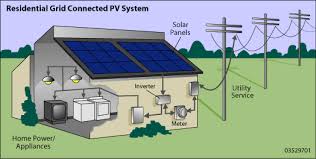
This same principle is now transforming communities on Earth. Homeowners can achieve energy independence through smart solar-plus-storage systems and Virtual Power Plants (VPPs). Central to this innovation is the MID (Microgrid Interface Device), which enables seamless interaction between the home and the utility grid.
Key Capabilities of the MID-Enabled Solar System
- Grid Connection and Disconnection
o The MID allows a home to disconnect from the utility grid during power outages, forming a standalone microgrid.
o When grid power is restored, the system can automatically reconnect, ensuring continuous and reliable energy supply.
- Energy Independence
o With integrated battery storage, homeowners can operate independently from the grid, maintaining power during emergencies or extreme weather events.
- Virtual Power Plant (VPP) Integration
o Excess energy generated by the solar system can be exported to the grid, providing financial benefits through net metering or energy credits.
o Potential earnings of $500 to $1,000 per year for grid support
o Communities of interconnected homes can form community microgrids, enhancing resilience and reducing reliance on centralized power systems.
- AI-Driven Energy Management
o Advanced artificial intelligence (AI) monitors energy production, consumption, and weather forecasts.
o The system can predict adverse weather conditions and automatically store energy in batteries to ensure uninterrupted power during outages.
- Economic Benefits
o Homeowners can save on electricity costs and earn income or credits by selling excess energy to the grid or neighboring homes.
o Solar storage + VPP+EV can save $150K–$200K over a lifetime,
o Now what if you have NetZero Home, with above config, 1.5 or 2x more answer in the book
o These systems typically include 25–30 year warranties, providing long-term reliability and return on investment.
A Comparison: Space Technology and Home Energy Systems
Feature Artemis II Solar System Home Solar + VPP System
Power Source Solar PV arrays Rooftop solar PV
Power Output ~11 kW ~5–15 kW typical plus
Energy Storage batteries Home battery systems
Grid Interaction Standalone spacecraft Grid-connected or islanded
AI/Automation Mission energy management Smart energy management
Resilience Supports deep-space missions Powers homes during outages, EV
Collaboration NASA & ESA Utilities & communities
The Future of Microgrids and Community Resilience
The evolution from traditional grid-dependent systems to AI-managed solar-plus-storage solutions plus VPP represents a transformative shift in energy infrastructure. Community microgrids and Distributed Resources (DR) enable neighborhoods to share locally generated clean energy, improving reliability and reducing carbon emissions.
Just as the Orion spacecraft relies on solar energy to sustain human life in space, 21st-century homes can harness the same renewable power to achieve resilience, sustainability, and financial independence, longevity. This convergence of space technology and terrestrial innovation underscores the potential of Virtual Power Plants as a cornerstone of future energy systems.
Vision Statement
“The same solar power that sustains astronauts on their journey to the Moon can empower homeowners on Earth to achieve energy independence, resilience, and economic prosperity.”
Key Takeaways
- Artemis II’s solar arrays generate ~11 kW, comparable to powering a large U.S. home.
- Solar-plus-storage systems enable homeowners to operate independently from the grid.
- The MID (Microgrid Interface Device) allows seamless grid connection or islanding during outages.( Stand Alone)
- Virtual Power Plants (VPPs) enable communities to share and sell excess energy, potentially earn $500 to $1,000 per year
- AI-driven energy management optimizes performance and prepares for adverse weather.
- 25–30 year warranties ensure long-term reliability and financial benefits.
- These innovations represent the future of resilient, sustainable energy systems, sustainable longevity living.
Conclusion
The Artemis II mission not only advances human exploration of space but also provides a compelling model for sustainable energy solutions on Earth. By adopting solar-plus-storage and VPP technologies, homeowners and communities can achieve energy independence, enhance resilience, and participate in a cleaner and more prosperous energy future. This synergy between space innovation and terrestrial application defines the next generation of energy systems for the 21st century.